
Buyer guide Updated
Powder Sachet Filling Machines: Dosing, Dust and Seal
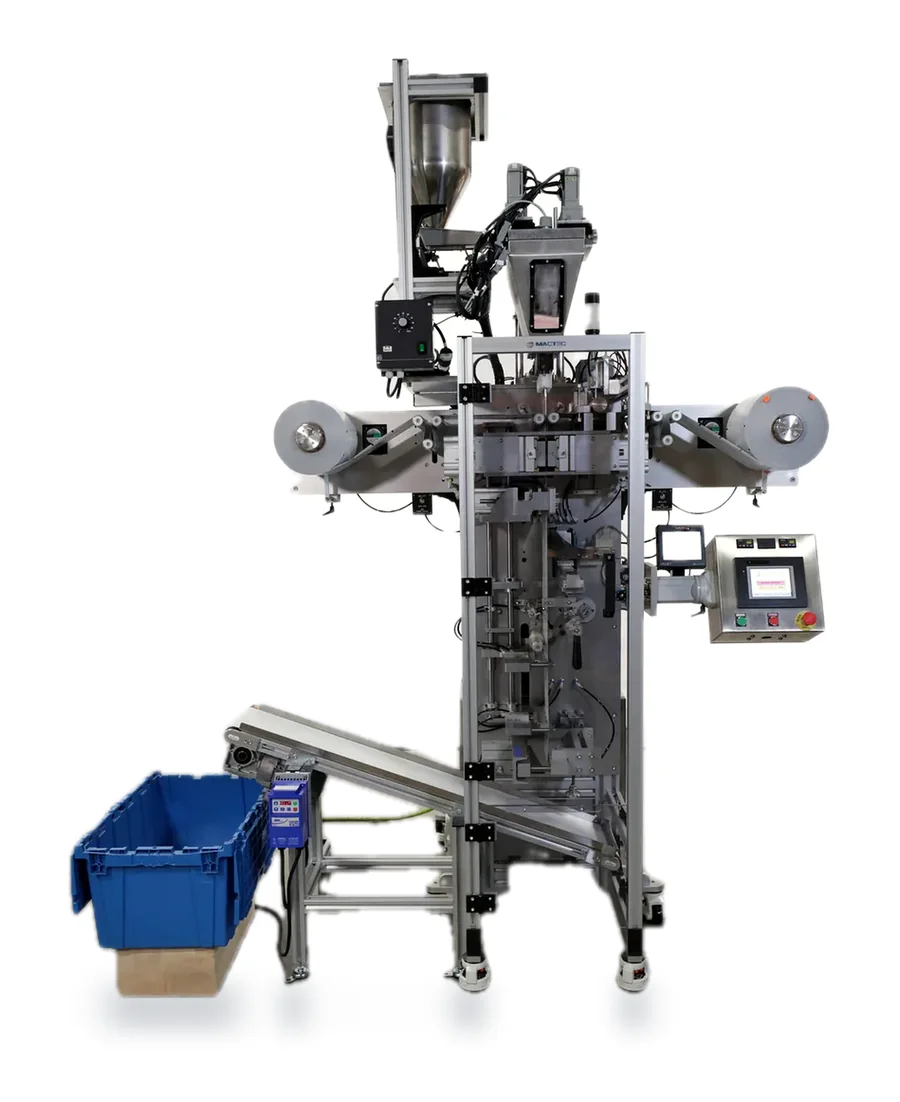
Powders go into sachets on the same vertical form fill seal machines that fill liquids: the machine forms the pouch from a roll of film, doses the powder in from above, then seals, perforates and cuts the finished sachet. Mactec’s MTVP160 and MTVP200 are configured for powders as well as liquids, tablets and capsules. Whether a given powder runs well comes down to four things: how it flows, how dusty it is, the dose, and the seal.
Which machine fills powder into sachets?
For single-dose powder sachets, such as a drink mix, a supplement, or a pharmaceutical or nutraceutical powder, the usual machine is a vertical form fill seal (VFFS) sachet machine. The powder is dosed into the open pouch and the pouch is sealed on four sides. The dosing system is selected around the product, the dose and the required accuracy; Mactec confirms it after seeing the powder. New to the process? Read What is a VFFS machine? first.
How does the powder flow?
Flow decides more than anything else. Two powders with the same name can behave very differently in a hopper.
- Free-flowing powders (granular, dry, uniform) dose easily and repeatably.
- Cohesive powders clump, bridge in the hopper or stick to surfaces; they need the dosing system matched to them.
- Hygroscopic powders take on moisture from the air and change behaviour during a shift; the room and the film matter.
- Mixed products, a powder with larger particles in it, can separate between the hopper and the pouch.
Tell your supplier the bulk density, whether the powder is fine or granular, and whether it cakes, clumps or absorbs moisture.
How dusty is it?
Fine powders raise dust when they fall into the pouch. Dust matters twice: it settles in the seal area, where it can weaken or mark the seal, and it settles on the machine and the room. Questions to answer:
- Does the powder cloud when poured?
- Must the fill area be kept clean between doses, and how?
- Does your facility need dust control around the machine?
These are questions a sample run answers better than a data sheet.
What dose, and how accurate?
Decide the target dose and the tolerance you can accept per sachet. A drink mix and a measured pharmaceutical dose have very different accuracy needs, and the dosing system follows from that. Also decide whether you need several doses or several products on one machine, and whether changeover between them must be quick.
The pouch, the film and the seal
- Pouch size. The MTVP160’s listed forming area is approximately 100 mm × 160 mm; the MTVP200’s approximately 140 mm × 200 mm, with a web width of up to approximately 200 mm for larger sachets or more lanes.
- Lanes. Multi-lane configurations make several sachets per cycle; the MTVP machines list 10–35 cycles per minute, depending on product and automation. Stick packs are a multi-lane configuration of the same machines.
- Film. Powders that take on moisture need a barrier film; confirm the material with your film supplier. The MTVP machines offer registration for preprinted film, inline lot and date coding, and tear notching.
- Seal. Powder in the seal area is the usual cause of weak seals. Ask how the fill is kept out of the seal zone and how seal quality is checked during the factory acceptance test.
Why send samples before buying
Powder behaviour is hard to predict. Representative samples of the powder and the film let Mactec see how it flows, how it doses and how it seals, and what output is realistic. Where practical, we run your samples on a Mactec machine at our Sayreville, New Jersey facility before you commit.
Related buyer guides
- What Is a VFFS Machine? Vertical Form Fill Seal Explained
- Liquid Pouch Filling Machines for Sauces, Creams and Liquids
- Vertical or horizontal pouch packaging?
Discuss your project with Mactec
Request an equipment quote using the form below. You do not need a finished specification. If you are unsure where to begin, contact Mactec and describe the product and the package you have in mind.
Talk to an engineer