
Mactec Packaging Equipment
Liquid Pouch Filling Machine: Sauces, Creams and Liquids
Small liquid pouches come up in many industries. Buyers ask us about portion sauces and dressings, meal-kit sauces, broth, lotions and creams, shampoo and conditioner samples, and two-part products like a resin and hardener packed together.
The products look different, but the same questions decide whether a liquid pouch filling machine will work. How thick is the product? Does it contain pieces? What temperature is it filled at? What should the pouch look like? This guide walks through those questions so you can describe your project clearly.
What kind of machine fills liquids into pouches?
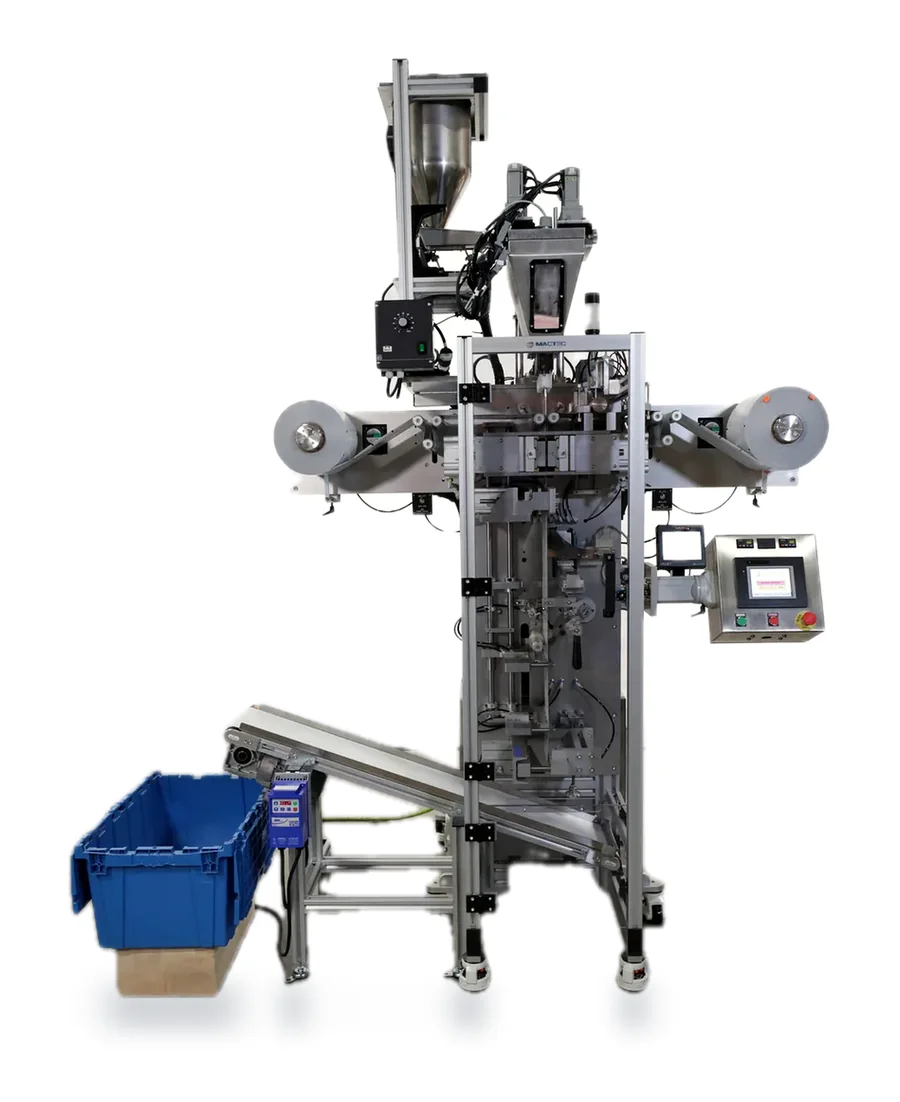
For measured liquid fills, the usual starting point is a vertical form-fill-seal machine. It forms pouches from rollstock (film supplied on a roll), doses the product, then seals and separates the finished packs in one continuous process.
Our MTVP160 and MTVP200 both work this way. Both are configured for liquids, powders, tablets or capsules, and both make four-sided-seal pouches with perforating and cutting. The MTVP200 has a wider web, up to approximately 200 mm, for larger pouches or more lanes.
If your product must be placed rather than dosed, see our vertical vs. horizontal pouch packaging guide.
How thick is the product, and does it have pieces?
Viscosity (how thick the product is and how easily it flows) shapes the filling system more than anything else. A thin broth, a mayonnaise-based sauce and a lotion all behave differently in a filler.
Questions to answer before you talk to any supplier:
- Is the product thin, pourable, thick or paste-like?
- Does the thickness change with temperature or over time?
- Does it contain particulates, such as chopped onion, vegetables or seeds? What is the largest piece?
- Does it separate, foam or string when it is dispensed?
- Is the product abrasive, sticky or sensitive to shear (breaks down when pumped hard)?
Our MTVP160 and MTVP200 can be configured with different liquid filling systems depending on the product, from free-flowing liquids to more viscous products. The filling technology is selected around the product, dose, viscosity, required accuracy and production speed, so there is no single viscosity limit for the machine. Ask each supplier what kind of filling system they propose for your product and why. Ask how it handles particulates, and how the fill volume is set and checked. The answer should come from testing your product, not from a catalog.
Is the product filled hot or cold?
Fill temperature affects the product, the film and the seal. Tell us:
- The product temperature at filling
- Whether the product must be held at temperature in the filler
- Any cooling or handling needed after sealing
Hot-fill applications can be evaluated based on the fill temperature, the product and the pouch material; there is no single hot-fill limit for the machine. Also confirm with your film supplier that the pouch material is suitable for that temperature.
What should the finished pouch look like?
Decide the pouch before you choose the machine, or at least narrow it down. Our MTVP machines are listed with four-sided seals. The listed forming area is approximately 100 mm × 160 mm on the MTVP160 and approximately 140 mm × 200 mm on the MTVP200. Usable pouch size and lane count depend on the package layout.
If you need a different format, such as a stick pack, tell us early. Multi-lane stick-pack packaging is one of the applications we can discuss as a custom project.
Other pouch questions buyers raise:
- Do you need several pouch sizes or two different liquids on one machine?
- Do you need a two-compartment pouch that keeps two liquids apart until use?
- Is the film preprinted? Our MTVP machines offer registration for preprinted film.
- Do you need lot or date coding on each pouch? Inline printing of lot and expiration information can be added.
- Do you need a tear notch so the pouch opens cleanly? Tear notching can be added to our pouch machines.
Two-liquid packages are possible. On one custom project, a vertical pouch machine filled two cavities with different liquids. A horizontal pouch machine then placed that pouch in its final package. See custom packaging machines for details, and read how we took on a complex two-liquid packaging application.
Can liquid in the seal area cause problems?
Yes. A seal must form through film that may have product on it, especially with sauces, oils and creams. Splashes, drips or strings of product in the seal area can weaken the seal or spoil its appearance.
Ask any supplier:
- How does the filler stop drips between doses?
- How is the seal area kept clean?
- How will seal quality be checked during the acceptance test?
These are questions your samples can answer, which is why testing matters.
Why send samples before buying?
Liquids rarely behave the way a data sheet suggests. Representative samples of the product and the film let us see how it doses, how it seals and what output is realistic. Where practical, we run your samples on a Mactec machine at our facility.
Machine speed on the MTVP models is listed as 10–35 cycles per minute, depending on product and automation. Finished output depends on your product, pouch and configuration, so agree on test conditions before you compare numbers.
What should we send for a liquid pouch quote?
- Product samples (or a close substitute), with a description of how it flows
- Largest particulate size, if any
- Fill volume per pouch and acceptable variation
- Fill temperature
- Pouch drawing or sample, and film specifications
- Number of pouch sizes and products
- Printing or coding needs
- Target output, batch sizes and shifts
- Cleaning and changeover expectations
Our packaging equipment RFQ checklist covers the rest.
Ready to test your product?
Send us your product details and pouch idea through the request a quote form. To compare forming areas and utilities, download the spec sheet from the MTVP160 or MTVP200 model page.
Related buyer guides
- Cup Filling and Sealing: Preformed or Formed Cups?
- What Drives Packaging Machine Cost? A Buyer's Guide
- Vertical or horizontal pouch packaging?
Discuss your project with Mactec
Request an equipment quote using the existing inquiry form. You do not need a finished specification. If you are unsure where to begin, contact Mactec.