
Mactec Packaging Equipment
Cup Filling and Sealing: Preformed or Formed Cups?
Buyers bring us a wide range of cup projects: small oral-solution cups with foil lids, reagent cups closed with an aluminum seal, sauce cups in several sizes, small liquid cups with printed lids, and single-serve coffee and tea. The first question in almost every one is the same: does the cup arrive at the machine already made, or should the machine make it?
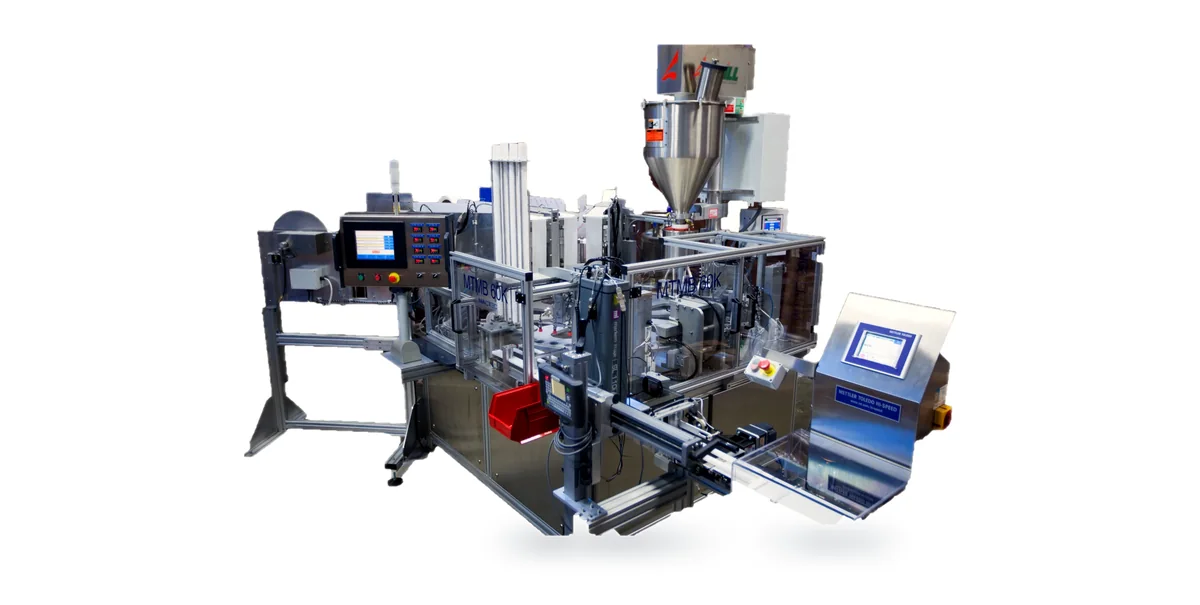
This guide covers that choice and the questions that follow.
What is the difference between preformed and formed-on-machine cups?
Preformed cups are rigid containers you buy from a cup supplier. The packaging machine loads them, fills them, places or applies a lid and seals it. This is the work our rotary monoblock fillers are configured for.
Formed-on-machine cavities are made from a roll of plastic film. The machine heats the film, forms cavities, fills them, seals lidding over them and cuts the packages apart. This is the form-fill-seal principle used on blister lines.
The trade-offs, in plain terms:
- Preformed cups give you a wide choice of cup shape, depth and wall thickness, because a cup supplier makes them. You hold cup inventory, and each cup size needs its own change parts.
- Formed cavities come from rollstock, so there is no cup inventory to manage. But cavity depth and size are limited by the forming tooling and the machine’s forming area.
Deep cups usually point toward preformed containers. If a shallow formed cavity would do the job, it is worth asking whether a form-fill-seal blister platform fits. Our NANO-XL and MT-150XL list liquids and powders among their applications, with published maximum forming depths of 16 mm and 19 mm. We would confirm suitability with your product and materials.
What does a rotary monoblock cup filler do?
A monoblock is one machine that brings several operations together around a rotary table. The table indexes, or steps, so each cup moves from station to station: container loading, filling, lid placement, sealing and discharge.
- MTMB-24 is a compact rotary filler for cups, tubes, vials and small bottles. It offers manual or automatic container loading, liquid or dry filling, cup sealing and simple product change parts. Published speed: 10–15 cycles per minute, depending on product size and fill.
- MTMB-60 is a larger multi-station platform set up for four cups per index, with a manual magazine loading option (a magazine holds a stack of cups that are fed one at a time), lid placement, sealing, presence sensors and vision-system options, and an optional discharge conveyor. Published speed: 15–25 cycles per minute, depending on product size and fill.
- Single-Cup Sealer is designed for compatible coffee and tea single-cup formats, including configurations that place a filter before filling and sealing.
Cycle rates are not finished-package output. Confirm format, configuration and acceptance conditions in the proposal.
Should the lid come from a roll or as pre-cut lids?
The right approach depends on your cup, lidding material and printing. Questions to settle early:
- What is the lidding material, and does it have a heat-seal coating that matches your cup material?
- Will lids be supplied pre-cut, or as a roll that is sealed and then cut to shape?
- Is the lid pre-printed? If so, does the print need to line up with the cup?
- Do you need a peel tab or a particular opening feature?
- What variable information, such as lot number and expiration date, must be printed?
We can print lot numbers, expiration dates and other variable data in line; the printer type depends on the package.
How accurate does the fill need to be?
Fill accuracy depends on the product, the fill volume and the filling method, so we start from a clear requirement:
- The target fill, by volume or by weight, for each cup size.
- The tolerance, and whether it is symmetrical. Some buyers specify a tolerance that allows slight overfill but no underfill.
- How you will measure it, and how many samples you check.
- What the product is like: thin liquid, cream, powder, foaming product or one with particles.
- Whether the product is filled hot, cold or at room temperature.
We then agree the samples and conditions for acceptance testing, rather than relying on a model name as the specification.
Can one machine handle several cup sizes?
Often, yes, with change parts or tooling for each size. Buyers commonly ask for two or three cup sizes on one machine. Our tooling changes are designed to be quick, often taking minutes, and the time depends on the machine, the tooling and the product.
Speed depends on product size and fill, so a larger cup may run at a different rate. Tooling for a new size can be added later through our tooling services.
What should you send us?
- Cup samples or drawings for each size, or a note that you want cups formed on the machine
- Product samples, or a description if samples aren’t practical
- Fill amount and tolerance for each size
- Lidding material: pre-cut or roll, printed or plain
- Variable data to print
- Inspection needs, such as a presence check
- Target output in finished cups per hour or per shift
- How cups will be loaded: by hand or automatically
- What happens after discharge, and any cleanroom or regulated-area requirements
Our guide to choosing monoblock filling and capping equipment covers the wider set of container and closure questions.
Ready to talk about your cups?
Compare the platforms on our monoblock fillers page, and download the spec sheet from the model page that looks closest. When you are ready, request a quote and include your cup and lidding samples. Where practical, we run samples on a Mactec machine at our facility.
Related buyer guides
- Liquid Pouch Filling Machine: Sauces, Creams and Liquids
- How to Work Out the Packaging Machine Speed You Need
- Choosing filling and capping equipment
Discuss your project with Mactec
Request an equipment quote using the existing inquiry form. You do not need a finished specification. If you are unsure where to begin, contact Mactec.