
Mactec Packaging Equipment
In-House Packaging vs. Contract Packaging: How to Decide
We build packaging machines, so you might expect us to tell you to buy one. That would not be honest advice. Some of the buyers who talk to us decide to stay with their contract packager, and for many of them that is the right call.
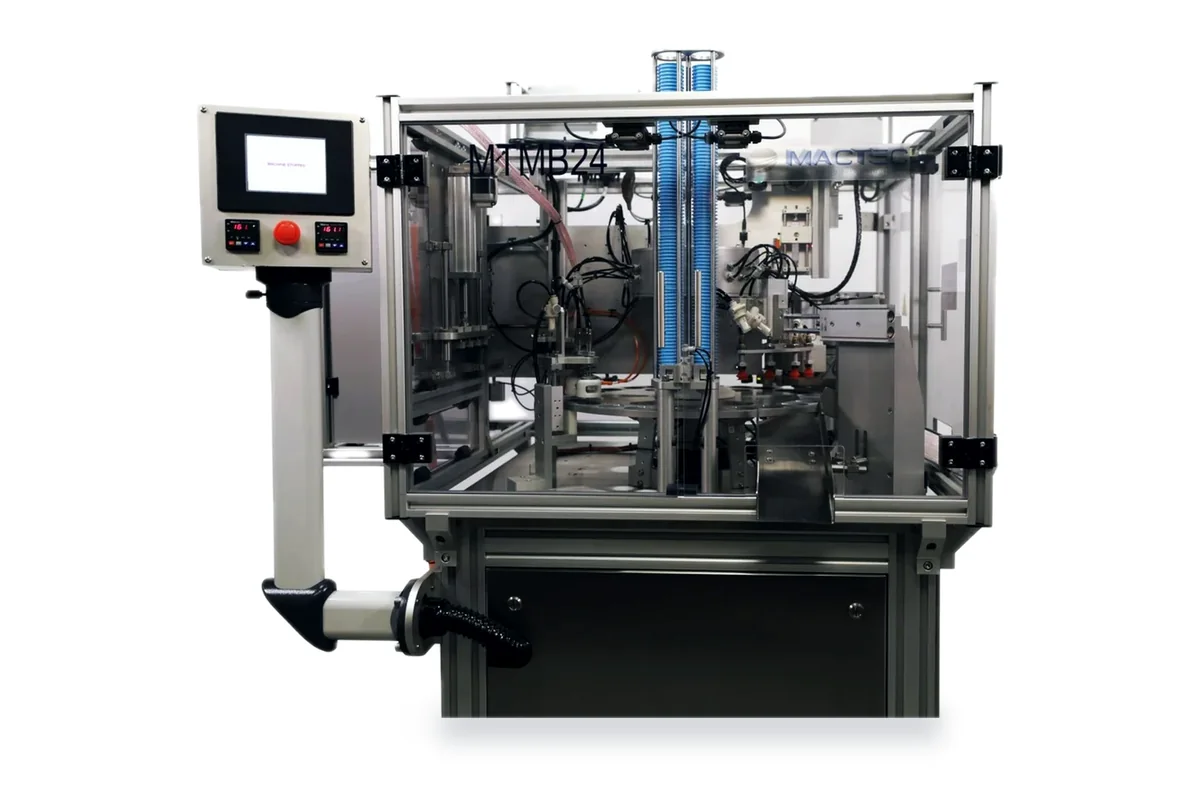
This guide sets out the questions that actually decide it, so you can make the choice with your own numbers.
When does a contract packager make more sense?
A contract packager (also called a co-packer) is a company that packages your product on its own equipment, with its own staff, under an agreement with you. Staying with one is often the better choice when:
- Your volume is low or uncertain. If annual quantities are small, or a product may not survive its launch, the equipment can sit idle.
- You run many package types. A contract packager may already own equipment for formats you would otherwise need several machines or tooling sets to cover.
- You do not have the people. A machine needs trained operators, someone to handle changeovers and maintenance, and someone who owns quality records.
- You do not have the space. Packaging needs floor space for the machine, materials, staging and finished goods, plus electrical power and compressed air.
- The full project cost is more than the machine. Buyers sometimes find that once validation, quality-system work and outside consultants are added, a small contract does not justify the investment.
None of these is a failure. Outsourcing lets you put capital and staff where they matter most to your business.
When does bringing packaging in-house make sense?
Buyers who are already working with a co-packer usually come to us for one main reason: control. That can mean:
- Schedule. You decide when a batch runs, rather than waiting for an open slot on someone else’s line.
- Quality. Your own team watches the process and handles deviations directly.
- Confidentiality. A new product, formulation or device stays inside your building. (If you talk to an equipment supplier first, ask for a confidentiality agreement before sharing drawings or samples; we can sign one.)
- Speed of change. Small-batch, clinical and development work often involves frequent package changes. With your own machine, a new format can mean new tooling rather than a new contract.
- Steady volume. When demand is predictable and ongoing, owning the step may be easier to plan around.
Who carries the regulatory responsibility?
This is the question to take to your quality and regulatory team before anything else. Bringing packaging in-house can shift work onto your organization: equipment qualification, batch records, training records, cleaning and change control.
We cannot tell you what applies to your product. What we can tell you is what we provide: on-site installation and validation, validation documentation support including IQ/OQ protocol support (the documented checks that a machine is installed and operates as specified), operator manuals and parts lists, and operator and maintenance training. Whether that is enough depends on your quality system and the people you have to run it.
Is there a middle ground?
Yes, and it is often overlooked.
Start manual. You do not have to automate everything at once. A machine can automate filling and sealing while an operator still loads each product. Our manual vs. automated packaging guide explains how to split the process into steps and decide which ones to automate.
Start with one product. Bring a single high-volume or confidential product in-house and leave the rest with your contract packager.
Start small. A compact machine for development or clinical batches can be a first step. On the blister packaging page, for example, the MT Table Top Sealer handles only the sealing step, while the NANO-XL forms, fills and seals in one compact machine.
If you plan to add automation later, say so during equipment selection. Future changes need application-specific review, and compatibility should be confirmed rather than assumed.
Questions to answer before you decide
Work through this list with operations, quality and finance in the same room:
- What are your real annual volumes per product, today and in two or three years?
- How many package formats and sizes do you run?
- What does your contract packager’s lead time cost you in delayed launches or held stock?
- Have you had quality or confidentiality problems you could solve only by owning the process?
- Who would operate, maintain and clean the machine, and who would own the quality records?
- Where would it go? Measure the space, including room for materials and finished goods.
- Which regulatory responsibilities would move to you, and does your team have time for them?
- What is the total project cost: equipment, tooling, installation, validation, training, consultants and staff time?
- Could a phased approach (one product, or manual loading first) reduce the risk?
If most answers point toward the contract packager, stay with it. We build equipment for contract packagers too, and a well-run one is a strong partner.
Want a second opinion on your numbers?
If you are still unsure, send us your product, package and volumes. We can tell you which machine would fit, what the budgetary proposal would separate out (base machine, feeders, printers, inspection, tooling), and what the project steps look like. See how a Mactec project works, use the RFQ checklist to gather your information, or request a quote when you are ready. A budgetary proposal is a starting point for planning, not a commitment.
Related buyer guides
- What Drives Packaging Machine Cost? A Buyer's Guide
- How to Work Out the Packaging Machine Speed You Need
- Prepare a packaging equipment RFQ
Discuss your project with Mactec
Request an equipment quote using the existing inquiry form. You do not need a finished specification. If you are unsure where to begin, contact Mactec.