
Mactec Packaging Equipment
Packaging Machine Integration with Robots and Integrators
More of our projects now include a third party: a system integrator. An integrator is the company that designs and builds the overall automated cell or line, often with robots, conveyors and controls, and ties the pieces together. Buyers often ask how a packaging machine fits into that kind of system.
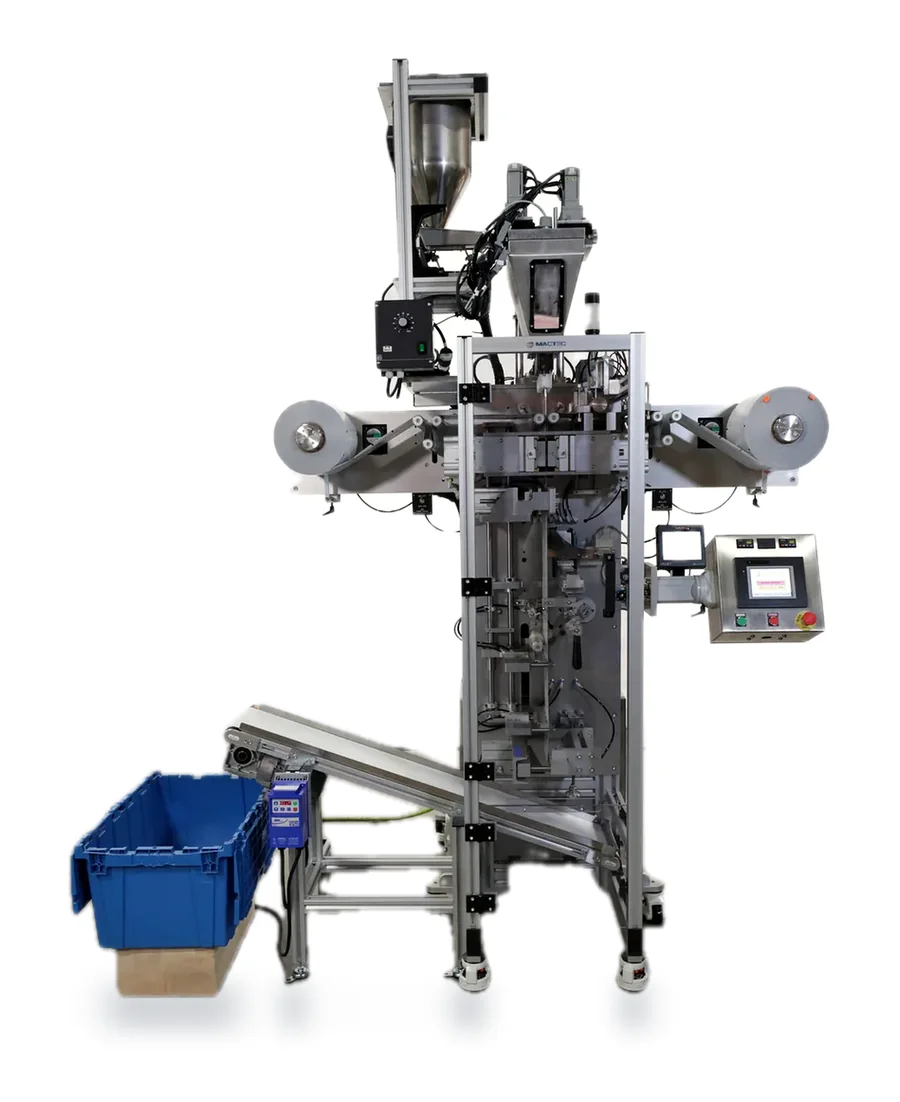
Typical examples: a robot loading product into a pouch machine; a multi-lane pouch system sitting inside a larger line; an integrator automating the handling of a test tube and desiccant while the packaging machine seals the package; robot-loaded cards going into foil pouches.
These projects go well when everyone agrees, early and in writing, who owns what.
Who is responsible for what?
There are usually three parties: you (the end user), the integrator and the packaging machine builder. Before purchase orders go out, agree on a responsibility list. A simple table with one row per item and one owner per row works well:
- Mechanical interface: where and how product is handed to the machine, and where finished packages leave.
- Electrical and control interface: which signals pass between the machine and the line, and how.
- Guarding and safety: who guards the robot cell, who guards the packaging machine, and how emergency stops are linked.
- Timing: who decides the cycle timing, and what happens when one side is not ready.
- Product handling: who owns feeding, orientation and placement.
- Testing: who tests what, where and against which criteria.
- Documentation and validation: whose documents cover which equipment.
- Support: who the user calls first when the line stops.
The point is not paperwork. Gaps between suppliers are where integrated projects slip.
What does an integrator need from the machine builder?
An integrator is designing around our machine, so they need specific information early:
- Footprint and access. Each model page lists dimensions. The MTHP150, for example, measures 2438 mm × 711 mm × 1981 mm.
- Utilities. Standard Mactec machines run on electrical power and compressed air. The MTHP150 lists 110 VAC at 15 amps and 12–16 CFM of air based on 20 cycles per minute.
- The load point. Where a robot or feeder places product, the space around it and the orientation required.
- Cycle rate and timing. The listed rate for the MTHP150 is 10–30 cycles per minute, depending on product characteristics. The integrator needs to know how long the load window is within each cycle.
- Signals. Machine ready, request product, cycle complete, fault and stop states. Agree the list and the method of exchange between the two control systems.
- Discharge. How finished packages leave. On the MTMB-60, for example, discharge arrangements are matched to the downstream process, with an optional discharge conveyor.
Ask your packaging machine builder for this as a written interface document, and have the integrator confirm it.
Which loading method fits the line?
Not every integrated project needs a robot. Options include:
- Manual loading by an operator, with the machine integrated only at the discharge end.
- Magazine loading, where products are stacked and fed from a magazine. The MTMB-60 lists a manual magazine loading option.
- Pick-and-place, where a mechanism picks each product and places it in the package. The MTHP150 lists pick-and-place customization and vision-system options.
- Robot loading by the integrator, where the robot belongs to the cell and the packaging machine provides the load point and signals.
Representative samples matter here. A product drawing alone may not show how an item behaves during feeding or placement.
How should factory acceptance testing work?
A factory acceptance test (FAT) is a structured test at the builder’s facility, before shipping, to show the machine meets the criteria agreed during the project. Customers can visit Mactec to witness factory acceptance testing against those criteria.
For integrated projects, invite the integrator to the FAT, not just the end user. If practical, test with the integrator’s interface signals simulated or connected, and with real product and packaging materials. Settle the acceptance criteria and samples beforehand. A model name is not a complete specification.
One documented example: two MT-150 machines forming cold-form deep-draw blisters holding a test vial and a desiccant pouch, with pinhole detection and vision presence checks, passed the customer’s factory acceptance test at Mactec.
Can we automate in phases?
Yes, if you plan for it. Many lines start with an operator loading the machine and add robotic loading later. The catch: do not assume an automatic feeder or robot can be attached to any existing machine later. Tell your builder the future plan now, and ask which provisions must be designed in today, such as space, control signals and access, and which additions would need more engineering.
Our manual vs. automated packaging guide lists the questions to ask.
What can Mactec supply?
Our custom packaging machines page covers integration with robotics and equipment you already use, such as a cartoner. For steps outside our platforms, such as tablet counting, capping, labeling or specialty insertion, we coordinate specialist suppliers and deliver one engineered solution. Our in-house design engineers work directly with you and your end customer, whether that customer is the integrator or the plant.
What should you send us?
Product and package drawings, representative samples, target output, which steps are automated or manual, printing and inspection requirements, the equipment before and after the machine, the integrator’s contact and scope, and your timeline. See how a Mactec project works for the steps from samples to start-up, then request a quote or download the spec sheet from the model page you are considering.
Related buyer guides
- How to Work Out the Packaging Machine Speed You Need
- Medical Device Pouch Packaging: Materials and Loading
- Manual or automated packaging?
Discuss your project with Mactec
Request an equipment quote using the existing inquiry form. You do not need a finished specification. If you are unsure where to begin, contact Mactec.