
Mactec Packaging Equipment
Vertical Form Fill Seal Machines
Mactec builds two vertical form fill seal machines, the MTVP160 and the MTVP200. Each forms a four-sided-seal pouch from a roll of film, fills a measured dose of liquid, powder, tablets or capsules, then seals, perforates and cuts the finished sachets. Both are designed and built at Mactec’s Sayreville, New Jersey headquarters.
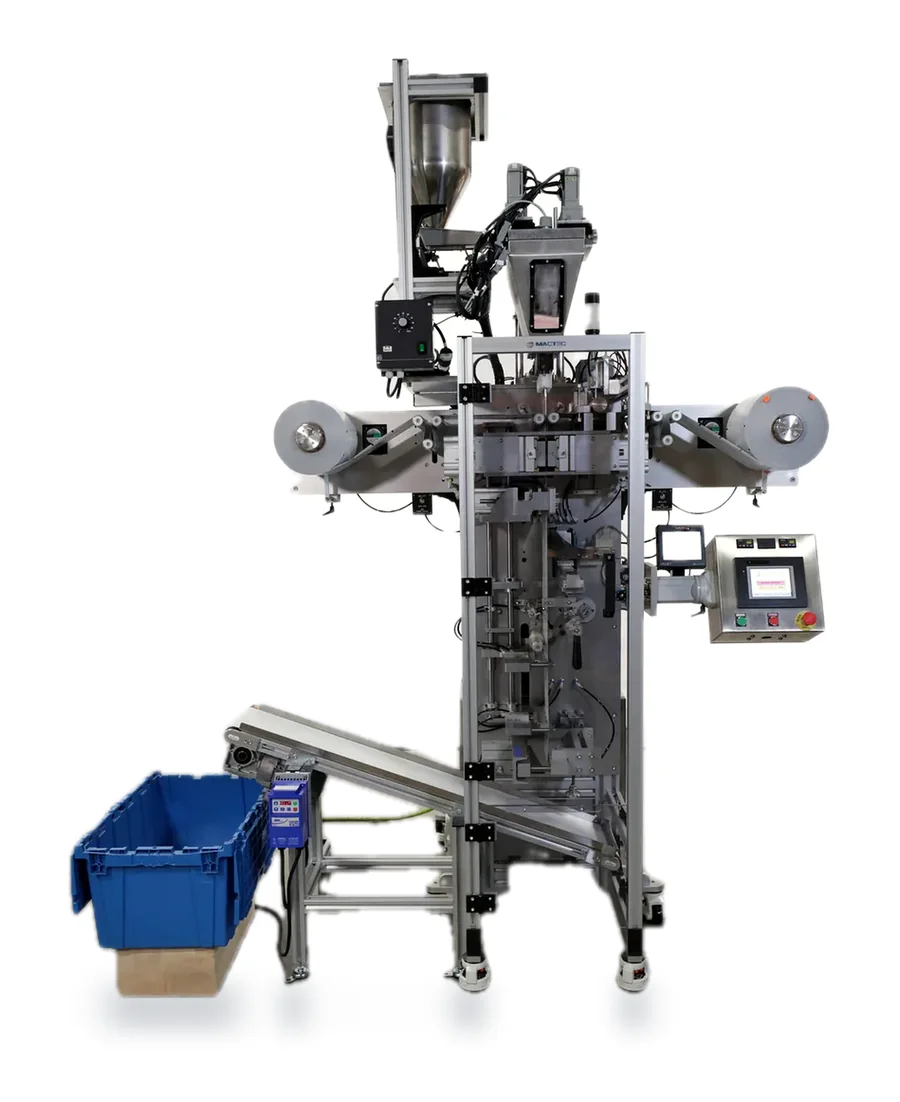
This page puts the two models side by side. If you are new to the process, the guide What is a VFFS machine? explains it in plain words; the pouch packaging machines page covers the whole pouch range, including the horizontal MTHP150.
Two VFFS machines, one platform
The MTVP160 is the compact model: a forming area of approximately 100 mm × 160 mm, for sachets, sample pouches and unit-dose packs; its usable web width is confirmed with engineering for your pouch format. The MTVP200 is the same machine with a wider web: a forming area of approximately 140 mm × 200 mm and a maximum web width of approximately 200 mm, for larger pouch formats or more lanes. Both list 10–35 cycles per minute, depending on product and automation, and both run multi-lane configurations, so one cycle can make more than one pouch.
What they pack
- Liquids and powders: single-dose sachets of a liquid, gel or powder, measured by the machine’s automatic filling.
- Tablets and capsules: counted unit-dose packs.
- Sachets and sample pouches: trial sizes and samples of a new product.
- Pharmaceutical and nutraceutical sachets: the MTVP200’s wider web for larger doses or multi-lane sample and unit-dose pouches.
Products that must be placed rather than dosed, such as a transdermal patch or a medical device, belong on the horizontal MTHP150 instead.
Published specifications
| Specification | MTVP160 | MTVP200 |
|---|---|---|
| Machine dimensions | 1219 mm × 1524 mm × 1828 mm (L × W × H) | 1219 mm × 1524 mm × 1828 mm (L × W × H) |
| Machine weight | Approximately 385 kg | Approximately 385 kg |
| Forming area | Approximately 100 mm × 160 mm | Approximately 140 mm × 200 mm |
| Maximum web width | Confirm maximum usable web width with engineering | Approximately 200 mm |
| Machine speed | 10–35 cycles per minute, depending on product and automation | 10–35 cycles per minute, depending on product and automation |
| Electrical requirements | 110 VAC at 15 amps | 110 VAC at 15 amps |
| Air consumption | 12–16 CFM based on 20 cycles per minute | 12–16 CFM based on 20 cycles per minute |
Specifications are application-dependent and are confirmed in Mactec’s proposal. Each model page has the full list and a one-page spec sheet that opens without a form.
Options on both machines
- Forming, filling, sealing, perforating and cutting in one line.
- Automatic product filling for liquids, powders, tablets or capsules.
- Multi-lane configurations.
- Registration for preprinted film.
- Four-sided seals and variable-data printing, such as lot numbers and expiration dates.
Which options your configuration includes is confirmed in Mactec’s proposal.
What to decide before you talk to us
- The product and its dose: a liquid, a gel, a powder, or counted tablets or capsules.
- The pouch size and the film: plain or preprinted, and whether the format fits the MTVP160’s forming area or needs the MTVP200’s wider web.
- Pouches per minute you need, and whether more than one lane makes sense.
- Lot and date coding, and any inspection steps.
Why Mactec
Compact machines for small-to-medium runs, built in New Jersey since 2004; factory acceptance testing you can witness; operator training; spare parts stocked at the factory; and, where practical, a sample run of your product and film on a Mactec machine before you decide.
Related buyer guides
- What Is a VFFS Machine? Vertical Form Fill Seal Explained
- Powder Sachet Filling Machines: Dosing, Dust and Seal
- Vertical vs Horizontal Pouch Packaging Guide
Discuss your project with Mactec
Request an equipment quote using the form below. You do not need a finished specification. If you are unsure where to begin, contact Mactec and describe the product, the pouch and the output you have in mind.
Talk to an engineer