
Mactec Packaging Equipment
Small Blister Pack Machines for Stability and Prototypes
Not every blister project starts with a production line. Buyers often ask us for something smaller: a way to run stability batches in-house instead of outsourcing them, a prototype of the final package before committing to a larger machine, or a pilot line for a product that is still changing.
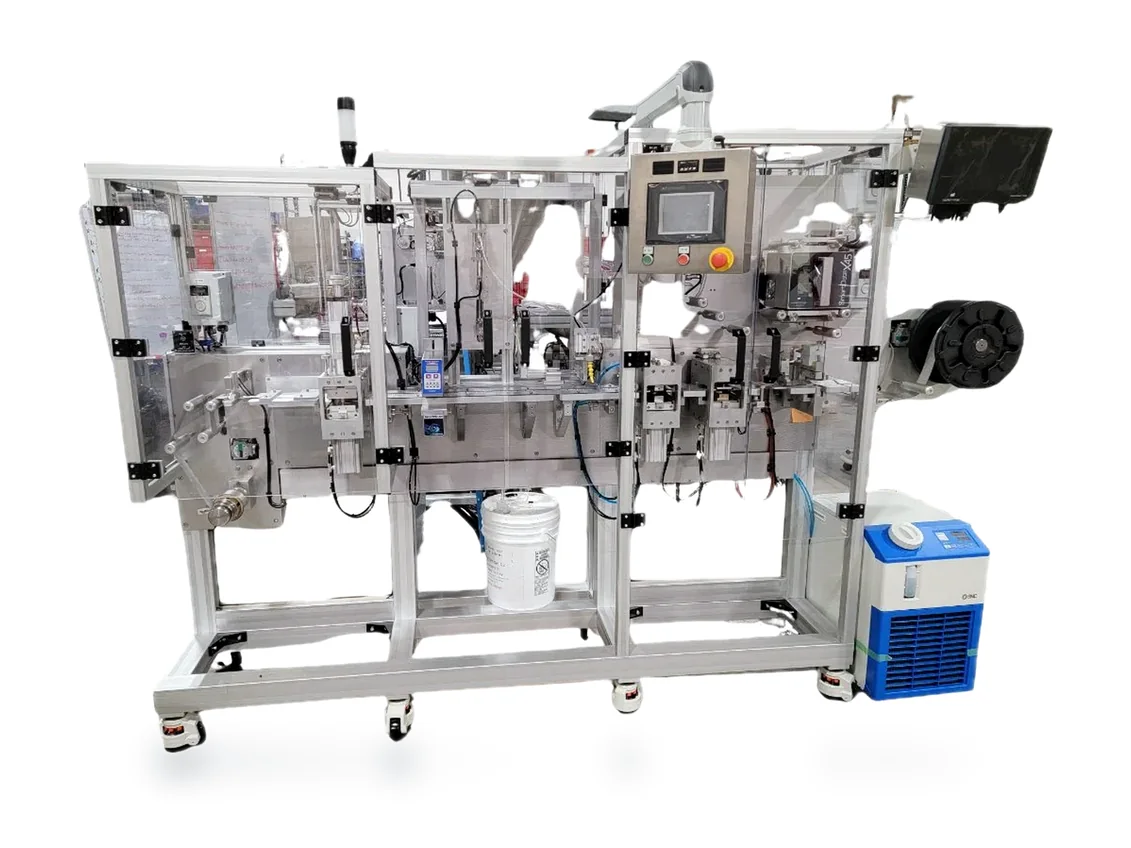
This guide covers how to choose a small blister pack machine for that kind of work, and what to settle before you ask for a quote.
Do we need a sealer or a complete form-fill-seal machine?
Start with what arrives at the machine.
A blister sealer handles the sealing step. If your blisters are already formed and the product is already loaded, a sealer may be all you need. The MT Table Top Blister Sealer is listed for low-volume blister sealing, package development, laboratory work and manual production. It has digital heat and timer controls, removable seal dies and tool-less change parts, and a listed rate of 1–10 cycles per minute.
A form-fill-seal machine also creates and fills the package. It forms cavities from a roll of film, places the product, seals the lidding, then perforates and cuts the cards. The NANO-XL is our compact form-fill-seal machine for laboratory, R&D, clinical and small-run work. Its listed speed is 5–35 cycles per minute, depending on product characteristics.
Our blister sealer vs. form-fill-seal guide goes through this decision step by step.
When is a table-top sealer enough?
A table-top sealer is often a good fit when:
- Batches are small and run occasionally
- You already have, or can buy, preformed blisters
- An operator will load every cavity by hand
- You are testing lidding materials or seal settings for a package concept
It is usually not enough when you need to form your own cavities, when the cavity design itself is under development, or when batch sizes make hand loading of every cavity impractical.
What about larger “small” batches?
Some buyers describe a batch in the tens of thousands of cards, run a handful of times a year, sometimes with camera inspection. That is still small-batch work, but it changes the math.
Work out the hours, not just the cycle rate. The arithmetic is simple: cycles per minute × cards (or cavities) made per cycle × 60 = machine output per running hour. A tool that makes two cards per cycle, running at 20 cycles per minute, produces 2,400 cards per hour of running time.
Then subtract the real-world work. Preparing materials, placing products, changing tooling and checking the first packages all matter in a small batch. A cycle-rate range alone does not tell you how long the complete run will take, and the rate you can actually run depends on your product.
If camera inspection is part of the plan, raise it early. Inspection is configured per project, and vision presence checks and pinhole detection have been built into earlier Mactec blister projects.
Can one machine handle several formats?
For development and clinical programs, the number of formats often matters more than the batch size. List every format and mark which are settled and which may still change.
Each format generally needs its own tooling, the set of forming, sealing and cutting parts that match one package. The NANO-XL lists quick product changeovers and application-specific change tooling. On our machines, tooling changes are designed to be quick, often taking minutes, depending on the machine, the tooling and the product. Our tooling services let you add new formats to the same machine later.
Should we build a prototype package first?
Often, yes. A prototype of the final package lets your team check the cavity, the lidding, the seal and the look before buying production equipment. Where practical, we run customer samples on a Mactec machine at our facility during the feasibility review.
Keep the limits in mind. A successful development trial does not by itself establish stability, production output or compatibility with a different operating environment. And a result with one material combination does not establish suitability for every other combination. Plan your trial around what it needs to prove.
What documentation will we need?
If the packages support stability studies or clinical supply, your quality team will set the documentation requirements. Ask any supplier what is included. We provide validation documentation support, including IQ/OQ protocol support (installation and operational qualification, the documented checks that a machine is installed and runs as specified), operator manuals and parts lists, plus operator and maintenance training.
Agree on the samples and conditions for an acceptance test rather than treating a model name as a complete specification.
What should we send for a quote?
- A package drawing or sample of the blister and lidding you want
- Representative product (agree on handling precautions first)
- Proposed blister and lidding materials, and cavity depth if forming is required
- Whether you need sealing only, or forming, filling and sealing
- Batch size, number of batches per year, and number of formats
- Printing (lot, expiry, barcode) and any inspection requirements
- Lab constraints: space, utilities, controlled-atmosphere rooms
If your concept is confidential, we can sign a confidentiality agreement before you share drawings or samples. Use our RFQ checklist to organize the rest.
Where to go from here
See our small-batch, clinical and R&D packaging page, compare the NANO-XL and MT Table Top Sealer spec sheets on their model pages, or request a quote with the package concept you have today. An incomplete concept is a fine place to start.
Related buyer guides
- Blister Packaging Materials: PVC, PVDC, Aclar or Foil?
- Unit-Dose Repackaging Equipment for Hospitals and 503B
- Blister sealer or form-fill-seal?
Discuss your project with Mactec
Request an equipment quote using the existing inquiry form. You do not need a finished specification. If you are unsure where to begin, contact Mactec.