
Mactec Packaging Equipment
Unit-Dose Repackaging Equipment for Hospitals and 503B
Hospital pharmacies and 503B outsourcing facilities often come to us with the same starting point: they repackage single doses today, and the process is slow or the equipment is getting old.
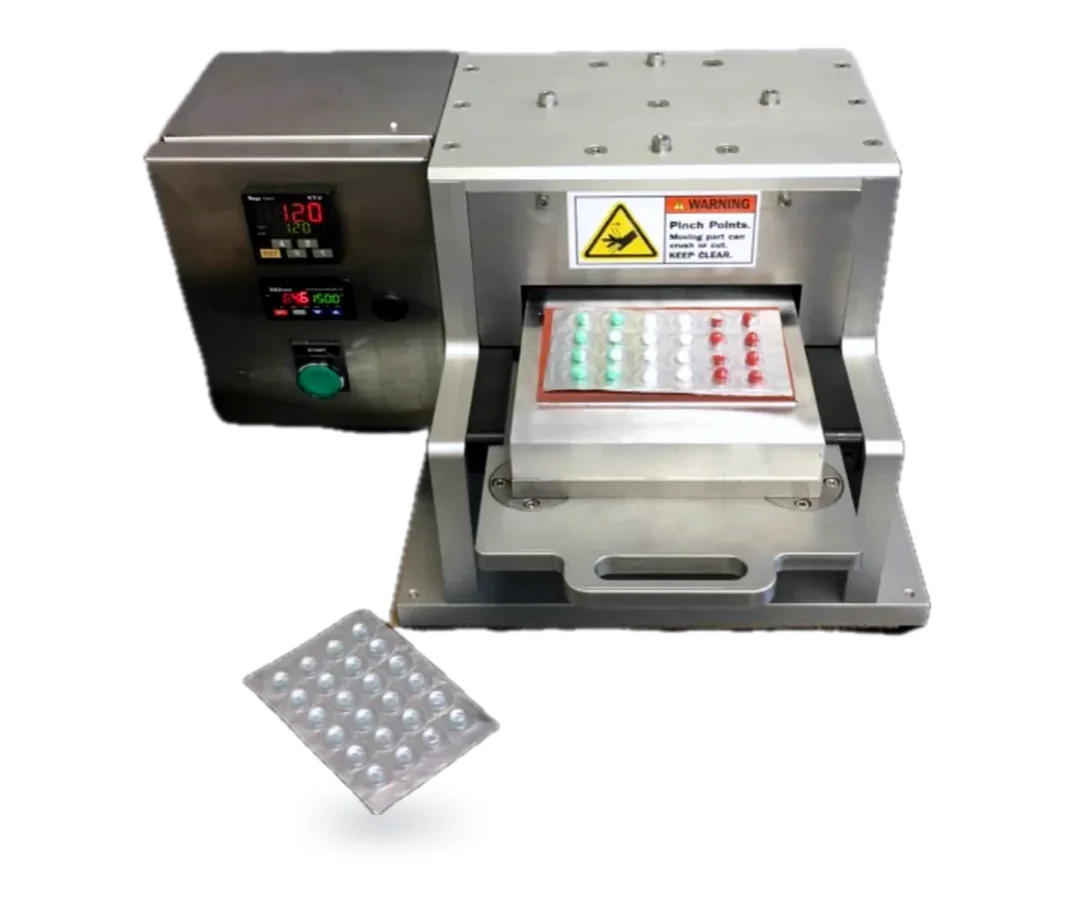
This guide walks through the decisions that shape unit-dose repackaging equipment. You do not need a finished specification to start. Most projects begin with a product, a package idea and a production goal.
Blister cards or unit-dose pouches: which package fits our workflow?
The first question is the package your nurses, technicians and dispensing systems expect to handle.
Blister cards. A blister is a formed cavity sealed with a lidding material. Buyers often ask us about blister card operations that replace older blister units or that feed an existing card-based dispensing workflow.
Unit-dose pouches. A pouch is formed from flexible film and sealed on four sides. A vertical form-fill-seal machine such as the MTVP160 forms the pouch from rollstock, fills it, then seals and separates the finished packs, with perforating and cutting to suit the package. It is listed for sachets and unit-dose packaging of liquids, powders, tablets and capsules.
If your downstream process is already built around one format, that usually decides it. If not, ask how each format will be stored, labeled, scanned and opened at the point of use.
Which machine size matches our volume?
We see three starting points for repack work:
- Seal prepared blisters by hand. The MT Table Top Blister Sealer handles the sealing step only. An operator loads a prepared blister and the machine seals it, at a listed 1–10 cycles per minute. It measures 304 mm × 355 mm × 247 mm, weighs about 34 kg and runs on 110 VAC.
- Form, fill and seal blisters in one compact machine. The NANO-XL forms, fills, seals, perforates and cuts blisters. Its listed speed is 5–35 cycles per minute, depending on product characteristics, and it runs on 110 VAC at 15 amps.
- Form, fill and seal pouches. The MTVP160, listed at 10–35 cycles per minute depending on product and automation.
A cycle rate is not a complete description of production capacity. Count the doses per cycle, the operator work, label or print checks, material changes and cleaning between products. Bring your real weekly volume, not a wish, and we will work through the arithmetic with you.
How will doses be labeled and identified?
Decide early:
- What variable data goes on each dose: lot number, expiration date, barcode, drug name or strength?
- Is the information printed on the package in line, or on preprinted material?
- Do you need the print positioned correctly, or read and verified by a camera? Those are different requirements.
Lot numbers, expiration dates and other variable data can be printed in line, and the printer type depends on the package. The NANO-XL lists lot, expiration-date and barcode printing options. Print verification (OCR/OCV, meaning a camera reads or checks the printed characters) is reviewed for each project.
How many tooling sets will we need?
Tooling is the set of format parts (forming, sealing and cutting dies, for example) that matches one package size. A repack operation rarely runs one product. List every tablet or capsule size and every package format you plan to run, and mark which are settled.
Each format may need its own tooling or seal die. The Table Top Sealer uses removable seal dies with tool-less change parts. Tooling changes on our machines are designed to be quick, often taking minutes, depending on the machine, the tooling and the product. Our tooling services also let you add new formats to the same machine later.
Manual loading or automatic feeding?
Many pharmacy operations start with an operator placing each dose. That keeps the machine simpler and suits frequent product changes. Automatic feeding helps as volume grows, but it has to be engineered around each product’s size and shape.
If you expect to automate later, say so now. Do not assume an automatic feeder can be attached to any existing machine later. Our manual vs. automated packaging guide lists the questions to settle first.
Will it fit in our pharmacy?
Space is often tight. Check the footprint, the room around the machine for loading and changeovers, and the utilities. Standard Mactec machines run on electrical power and compressed air, and each model page lists its requirements. If the machine will sit in a cleanroom or regulated area, tell us; product-contact parts and cleaning access are reviewed with your quality team during the proposal.
What documentation should we ask for?
Your quality and regulatory team decides which requirements apply to your operation. On our side, we install and validate the equipment on site and provide validation documentation support, including IQ/OQ protocol support (installation and operational qualification, the documented checks that the machine is installed and operates as specified), operator manuals and parts lists, plus operator and maintenance training.
Ask any supplier exactly which documents are included in the proposal and which your team will write.
What should we send to start?
- The products you repackage, with sizes and any handling restrictions
- Your current package (a sample or photo) and the format you want
- Weekly or daily dose volume, shifts and staffing
- Every label field and whether print must be verified
- Number of formats now and expected later
- Available floor space and utilities
- The equipment or system before and after the packaging step
Our RFQ checklist organizes the rest. See also our 503B pharmacy packaging equipment page and why 503B pharmacies are a market where our equipment continues to excel.
Ready to compare options?
Download the spec sheet from the NANO-XL or MT Table Top Sealer page, or request a quote with what you know today. We will help you work out the rest.
Related buyer guides
- Blister Packaging Materials: PVC, PVDC, Aclar or Foil?
- How to Replace an Aging Blister Packaging Machine
- Blister sealer or form-fill-seal?
Discuss your project with Mactec
Request an equipment quote using the existing inquiry form. You do not need a finished specification. If you are unsure where to begin, contact Mactec.