
Mactec Packaging Equipment
How to Replace an Aging Blister Packaging Machine
Buyers usually start looking for a new blister machine for one of a few reasons. The old machine keeps breaking down. Parts are no longer available. Or a machine bought from another supplier never ran properly because its feeding system could not handle the product.
Whatever the reason, a replacement project goes better when you start from what your current line actually does. This guide covers what to document, where replacement projects tend to go wrong, and how to plan the switchover.
What should we document about the machine we have now?
Before you talk to any supplier, write down how the current machine is set up and how it really performs. Use this checklist:
- Formats: every blister card you run, with drawings or physical samples of the finished pack
- Tooling: cavity layout, cavity depth, card size, perforations and any existing tooling drawings
- Materials: forming film and lidding specifications, and whether you thermoform (heat plastic film into cavities) or cold form (press a foil laminate into shape without heat)
- Product: samples of each product, plus anything that makes it hard to handle
- Loading: how product gets into the cavities today, by hand or with a feeder
- Printing and inspection: lot, expiry and barcode printing, and any camera checks
- Real output: finished cards per shift, not the nameplate speed
- Footprint: the floor space available, including room for operators and material rolls
- Utilities: the electrical supply and compressed air available at the location
- Problems: what goes wrong today, and how often
Real numbers beat nameplate numbers. A machine’s cycle rate is not a complete description of production capacity. Changeovers, loading and material replenishment all count.
Can we keep our existing blister formats?
Often, yes. Keeping your current card dimensions avoids reworking cartons, artwork and downstream steps. Tell us which formats must stay exactly the same and which you are willing to change.
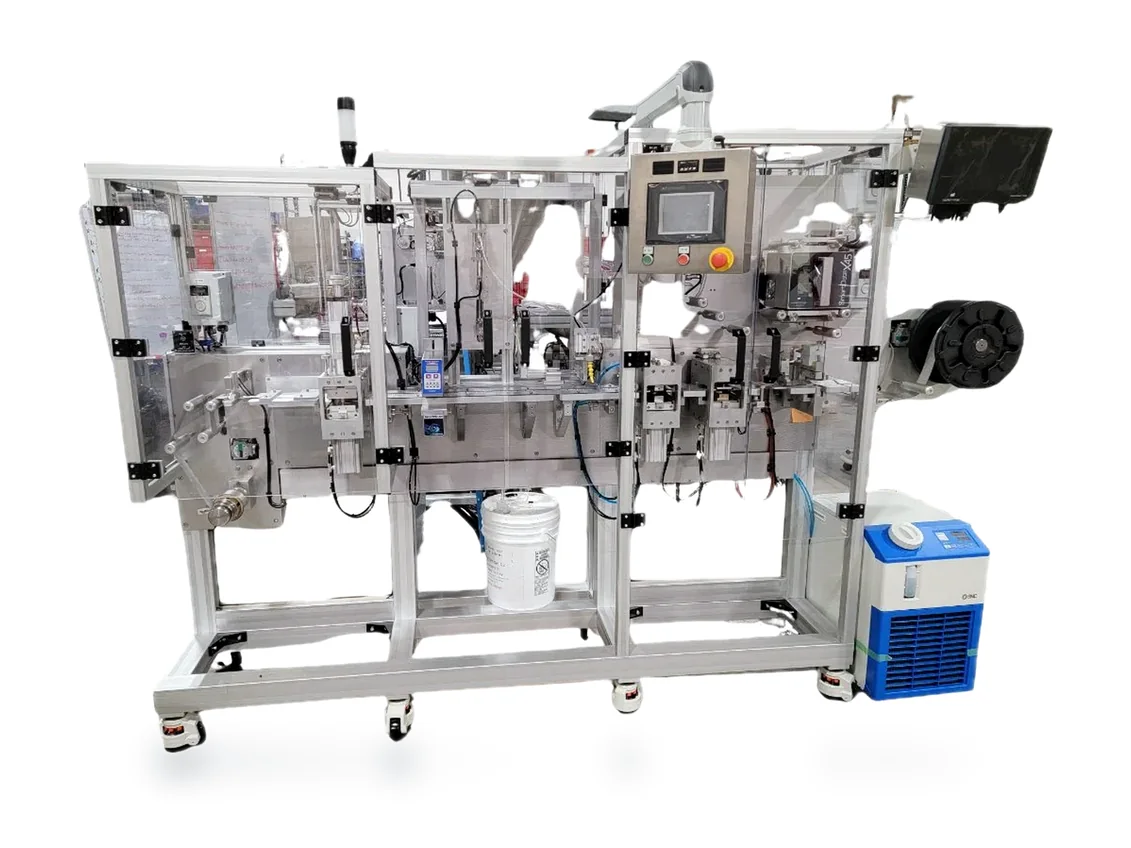
Our machines have limits, so check them early. The NANO-XL lists a forming area of approximately 80 mm × 95 mm, a maximum forming depth of 16 mm and a maximum web width of 105 mm. The MT-150XL lists a forming area of 150 mm × 150 mm, a maximum forming depth of 19 mm and a maximum web width of 160 mm. Both support thermoforming and cold forming. If your existing card falls outside these figures, that is a conversation to have before anything else.
If your blisters arrive already formed and loaded, you may only need the sealing step. In that case, the MT Table Top Blister Sealer is the starting point. Our blister sealer vs. form-fill-seal guide explains the difference.
Why do replacement projects fail?
Feeding is often the hardest part of a blister project. Forming and sealing are well understood. Getting a specific tablet, capsule, gummy or device to separate, orient and drop into every cavity, cycle after cycle, is the hard part.
A product drawing alone may not show how an item behaves during feeding. That is why we ask for representative samples and, where practical, run them on a Mactec machine at our facility before you commit. Both form-fill-seal models offer manual or automatic filling, selected for the application.
When you compare proposals, ask each supplier:
- How exactly will my product be fed and placed?
- Have you run my product, or one like it?
- What samples and conditions will we use for the acceptance test?
What about parts and service on the new machine?
An old machine with no parts available is a common reason buyers call us. Ask any supplier where parts come from and who services the machine.
Spare parts for Mactec machines are stocked at our headquarters in Sayreville, New Jersey, where the machines are designed and built. We provide operator manuals and parts lists, on-site service is a phone call away, and our tooling services let you add new formats to the same machine later. See parts and service for details.
Our standard parts and service support is focused on Mactec machines. If you have another manufacturer’s blister machine, we are happy to review it and see whether a retrofit, tooling requirement or other modification makes sense. When you are replacing an existing machine with a Mactec system, we can also review that equipment and discuss trade-in options case by case.
How do we handle validation and the switchover?
In a regulated operation, a new machine means requalification. Plan it before the machine ships, not after.
- Agree on acceptance criteria and test samples during the project.
- Witness factory acceptance testing at Mactec against those criteria.
- Plan installation and validation on site. We provide validation documentation support, including IQ/OQ protocol support, plus operator and maintenance training.
- Keep the old machine running in parallel, if space allows, until the new one is qualified and your team is confident with it.
Running both machines for a period is often the safest way to protect supply during the changeover.
What should we send to start?
Start with the checklist above, even if some items are incomplete. Add your target output, batch sizes and planned product changes. Our packaging equipment RFQ checklist organizes the rest.
Ready to replace your blister machine?
Send us your current formats, samples and the problems you want to solve through the request a quote form. To compare footprints and forming areas with your current line, download the spec sheet from the NANO-XL or MT-150XL model page.
Related buyer guides
- Blister Packaging Materials: PVC, PVDC, Aclar or Foil?
- Small Blister Pack Machines for Stability and Prototypes
- Blister sealer or form-fill-seal?
Discuss your project with Mactec
Request an equipment quote using the existing inquiry form. You do not need a finished specification. If you are unsure where to begin, contact Mactec.