
Mactec Packaging Equipment
Vial Filling Machines & Bottle Filling and Capping Machines
Our engineers review your samples and drawings and run samples on a Mactec machine where practical.
Select a vial filling and capping machine, a bottle filling and capping machine, or cup and tube filling equipment around three things: the product, the container and the closing operation. A monoblock combines selected operations on one platform; the configuration must match the actual application.
Map the work from empty container to finished package
List container loading, filling, closure placement, closing, inspection and discharge separately. Decide which tasks need equipment and which will remain manual. Include samples of each container and closure you plan to run.
Match the closing operation to the package
- Vials and bottles: identify the cap or closure, its placement and the required closing method.
- Cups: define the fill, lid or lidding material and sealing requirements.
- Tubes: define any tip-insertion, sealing or crimping operation using the actual tube and closure.
Cap torquing, sealing and crimping are not interchangeable. Ask Mactec to confirm the tooling and operations for each proposed format.
Compare rotary platforms
The MTMB24 provides a starting point for compact rotary filling with application-specific closing options for small rigid containers. The MTMB60 supports a discussion of multi-station filling and sealing requirements. Compare them on the monoblock filling and capping page, then review each model’s specifications.
For compatible coffee and tea cups, review the dedicated Single-Cup Sealer separately. Do not assume that a single-cup configuration is a general vial or bottle filler.
Define filling and output conditions
Describe liquid or dry-product characteristics, the intended fill amount and acceptable variation. Review dosing, product-contact components, cleaning and operator involvement. If you need to run several containers, identify the change parts and setup tasks for each one.
Compare acceptable finished containers under stated conditions, not only an index or cycle rate. Filling time, containers per index, loading and inspection can all affect the complete process. Confirm the expected result for your configuration during project review.
Plan small-container handling and additional operations
Bring the full bottle or vial size range, closure drawings and representative samples. Ask how each format will be supported, transferred and presented for filling and closing. A compact footprint alone does not establish that the handling method suits every container.
If your process includes an insert, an additional sealing step or downstream labeling, list it explicitly. Define the component, its position in the sequence and the party responsible for evaluating it. These requirements are not implied by the term monoblock.
Who loads the containers?
Confirm whether loading remains manual or requires a feeding system. With manual loading, a monoblock runs as a semi-automatic filler; with automatic container loading, loading, filling and closing are integrated on one automated filling platform. For tubes, specify loading separately from filling, sealing and coding. Review the packaging automation guide and RFQ checklist before comparing configurations.
Vial filling machine specifications
Mactec's vial filling machines are the MTMB24 and MTMB60 rotary monoblocks: each fills a vial, bottle, cup or tube and then seals, caps or crimps it on the same indexed table. The values below are the ones published on each model page.
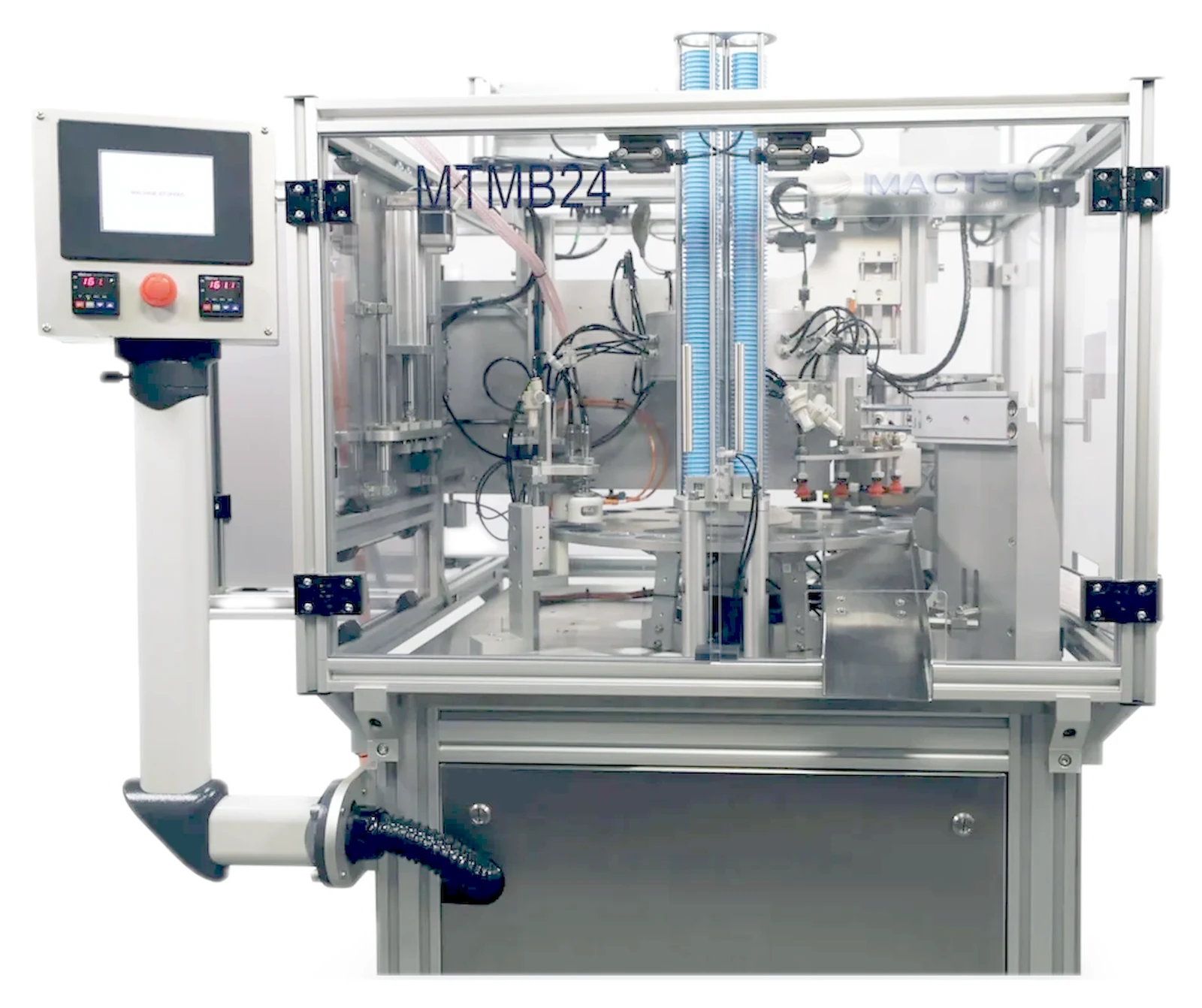
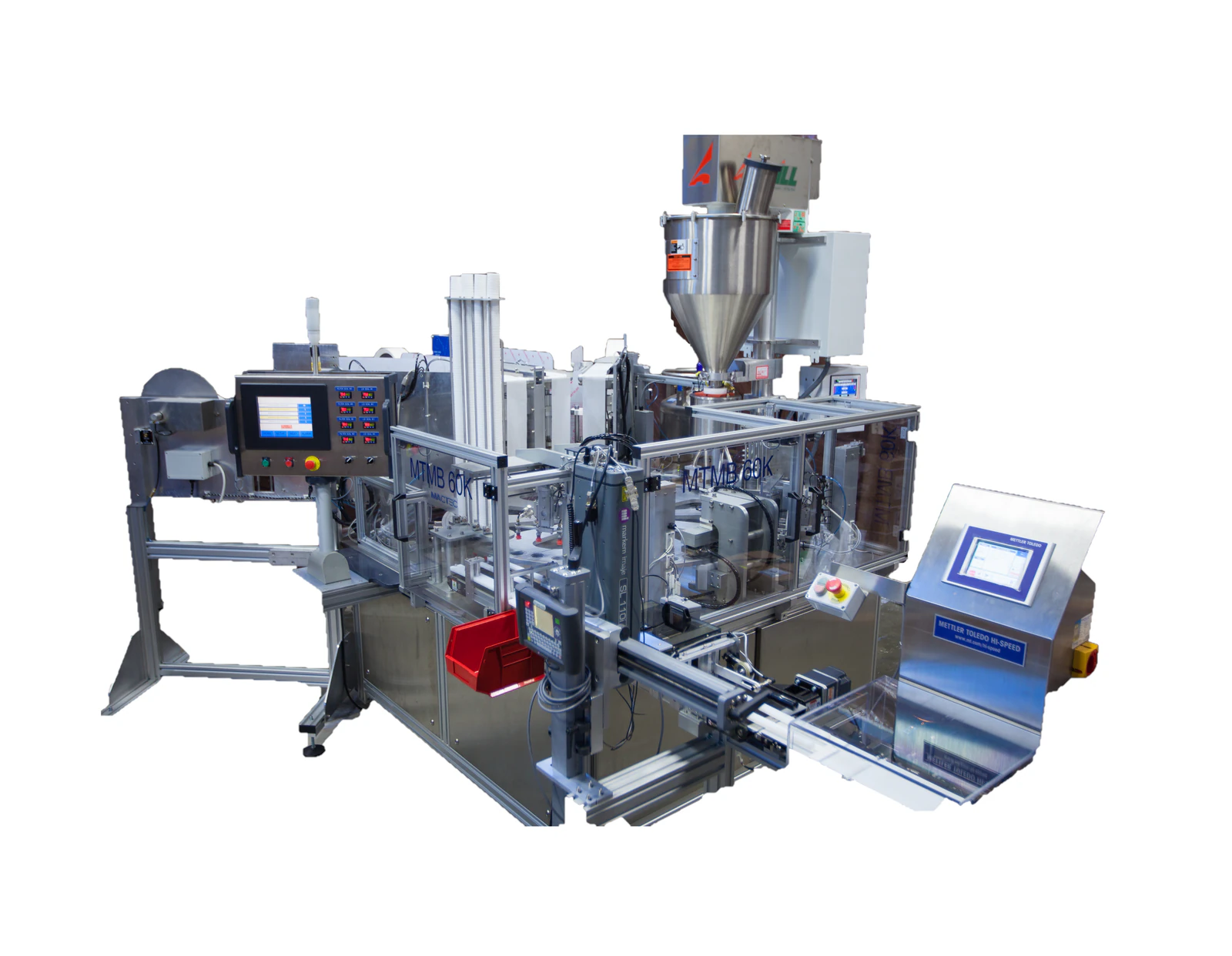
| Specification | MTMB24 | MTMB60 |
|---|---|---|
| Machine footprint | 914 mm square frame | 72-inch square frame |
| Rotary table | Turret diameter 813 mm | Fill table 1524 mm diameter |
| Containers per index | One | Four cups per index |
| Index tolerance | High-precision indexing, ±0.003 inch | High-precision indexing, ±0.003 inch |
| Machine speed | 10–15 cycles per minute, depending on product size and fill | 15–25 cycles per minute, depending on product size and fill |
| Electrical requirements | 110 VAC at 10 amps | 220 VAC at 40 amps |
| Air consumption | 8–14 CFM based on 20 cycles per minute | 20–30 CFM |
Specifications are application-dependent and must be confirmed in Mactec’s proposal.
MTMB24 model pageMTMB60 model pageMTMB24 spec sheet (PDF)MTMB60 spec sheet (PDF)
Frequently asked questions about filling and capping equipment
Can one configuration run every listed container?
No. The container and closure need matching handling, tooling and operations. Review the complete list of intended formats before selecting equipment.
What if the product or closure is not finalized?
Share the current concept and the choices still open. Mactec can discuss which decisions affect equipment selection; a finished specification is not required for an initial inquiry.
Does a pharmaceutical application imply sterile or aseptic capability?
No. State the actual process, environment and documentation requirements. Suitability for a regulated application must be evaluated separately; it cannot be inferred from the word monoblock.
For frequent product changes, review equipment selection for contract packagers and CDMOs.
Discuss your container and filling project
Start with the product, container and closure. Include available samples or drawings in the follow-up discussion.
Related guides
- Cup filling and sealing: Preformed or formed cups, lidding, printing and changeovers between sizes.
- Working out the machine speed you need: Turn a production target into cycles per minute and compare finished output.
- Which Filling Method for Small-Batch Liquids and Powders?: Piston, peristaltic, gravity, pump, auger and weigh-filling in plain words, and what decides the method.
- Cup Filling and Sealing Machines: The MTMB24, MTMB60 and Single-Cup Sealer side by side: which cups they fill and seal, lids, fill accuracy and what to send.
Talk to an engineer