
A thermoforming blister machine makes the blister on the machine. It heats a plastic forming film until it softens, forms it into cavities, fills them, seals the lidding over them, then perforates and cuts the finished cards. Mactec builds two of these thermoforming machines at its Sayreville, New Jersey headquarters: the compact NANO-XL and the midsize MT-150XL. Both also run cold forming.
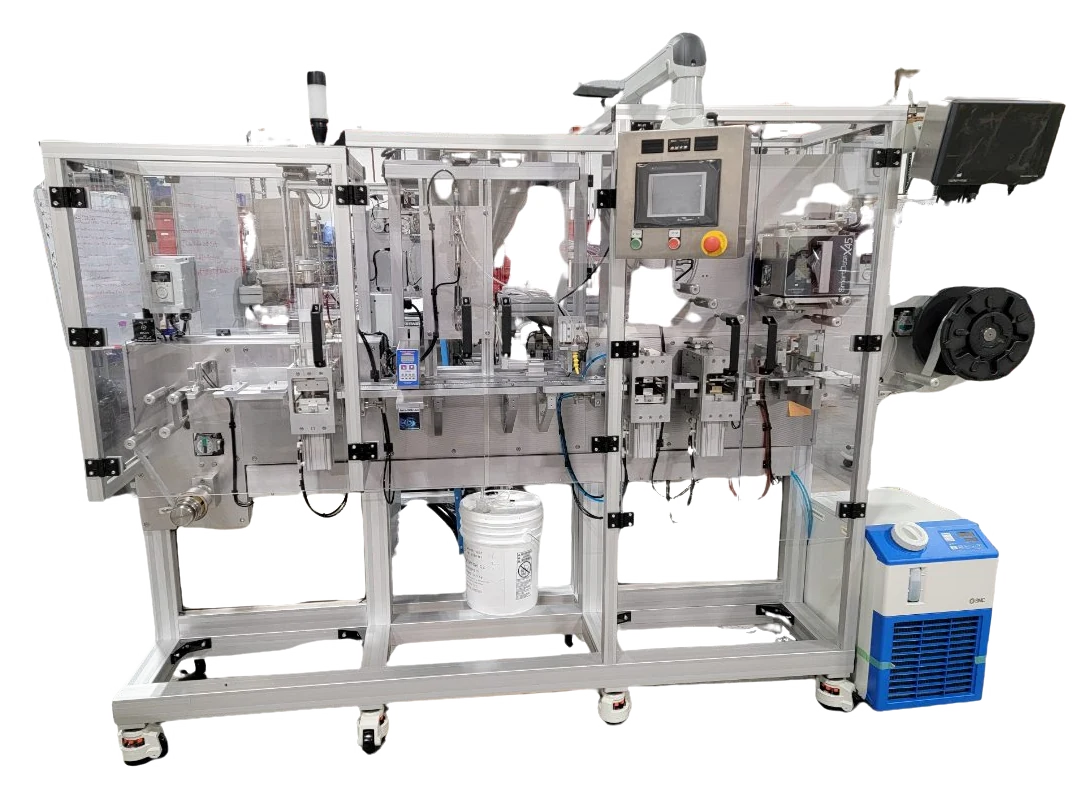
This page explains how a thermoforming machine for blister packs works, how thermoforming compares with cold forming, and how the two machines differ. If you are looking for a stand-alone thermoformer that makes trays or cups for another line, these are not that machine: on the NANO-XL and MT-150XL the forming station is part of a complete blister line.
How a thermoforming blister machine works
- Heat and form. Forming film is pulled from a roll, heated until it softens and shaped into cavities by the forming tooling. Because the cavities are formed from a roll of film, there is no tray inventory to manage.
- Fill. The product goes into the cavities by hand or with an automatic feeder: tablets and capsules, liquids and powders, gummies or medical devices.
- Seal. Lidding is sealed over the cavities. Its heat-seal coating has to match the forming film.
- Perforate and cut. The cards are perforated and cut apart. Lot, expiration-date and barcode printing are listed options on the NANO-XL, and the MT-150XL offers printing for variable package information.
Thermoforming or cold forming?
Thermoforming heats a plastic film until it softens, then forms it into cavities. The result is usually clear or tinted, so the product can be seen. Common thermoforming films include PVC, PVC/PVDC, PVC/Aclar and PET; the blister packaging materials guide explains each one.
Cold forming stretches an aluminum-based laminate into cavities with a plug, without heat. The result is opaque and blocks light, moisture and gases, and cold-form cavities generally need more area for the same product.
Both the NANO-XL and MT-150XL support thermoforming and cold forming. The forming tooling is different for each, so switching materials can mean new forming and sealing tooling and new trials. Your stability data and your materials supplier have the final word on which film your product needs.
Two thermoforming machines, two sizes
The NANO-XL is the compact model for laboratory, R&D, clinical and small production runs. The MT-150XL is for small-to-medium batch production in pharmaceutical, nutraceutical, cosmetic and related applications.
| Specification | NANO-XL | MT-150XL |
|---|---|---|
| Best for | Laboratory, R&D, clinical and small runs | Small-to-medium batch production |
| Forming area | Approximately 80 mm × 95 mm | 150 mm × 150 mm |
| Maximum forming depth | 16 mm | 19 mm |
| Maximum web width | 105 mm | 160 mm |
| Machine dimensions | 1752 mm × 711 mm × 2121 mm (L × W × H) | 4153 mm × 1092.2 mm × 2248 mm (L × W × H) |
| Machine weight | Approximately 275 kg | 636 kg |
| Electrical requirements | 110 VAC at 15 amps | 220 VAC, 3 phase at 25 amps |
Specifications are application-dependent and are confirmed in Mactec’s proposal. Each model page has the full list and a spec sheet that opens without a form.
Blisters already formed and filled?
If your blisters arrive at the machine already formed and loaded, you may not need a thermoforming machine at all. The MT Table Top Blister Sealer handles the sealing step only, with digital heat and timer controls and removable seal dies. Read blister sealer or form-fill-seal: which do you need?
What to send us
- Product samples and dimensions
- What the product is sensitive to: moisture, oxygen, light, or none
- Proposed forming film and lidding, with supplier data sheets
- Package drawing, cavities per card and cards per cycle if known
- Printing: pre-printed lidding, variable data, or both
- Batch sizes, number of formats and target output
Where practical, Mactec runs your samples on a machine at its Sayreville, New Jersey facility before you commit.
Built and supported in New Jersey
Mactec designs and builds every machine at its Sayreville, New Jersey headquarters, and offers factory acceptance testing you can witness, on-site installation and validation, IQ/OQ protocol support, operator training and spare parts stocked at the headquarters. Tooling services, offered since 2016, add new products or formats to a machine you already own. Customers include Bristol Myers Squibb, Teva, Bayer, Catalent, Eurofins, Alcami and Cambrex.
Related guides
- Blister Packaging Materials: PVC, PVDC, Aclar or Foil?
- Blister Sealer or Form-Fill-Seal Machine: Which Do You Need?
- Small Blister Packaging Machines for Labs and Clinical Trials
Discuss your project with Mactec
Request an equipment quote using the form below. You do not need a finished specification. If you are unsure where to begin, contact Mactec and describe the product and the package you have in mind.
Talk to an engineer